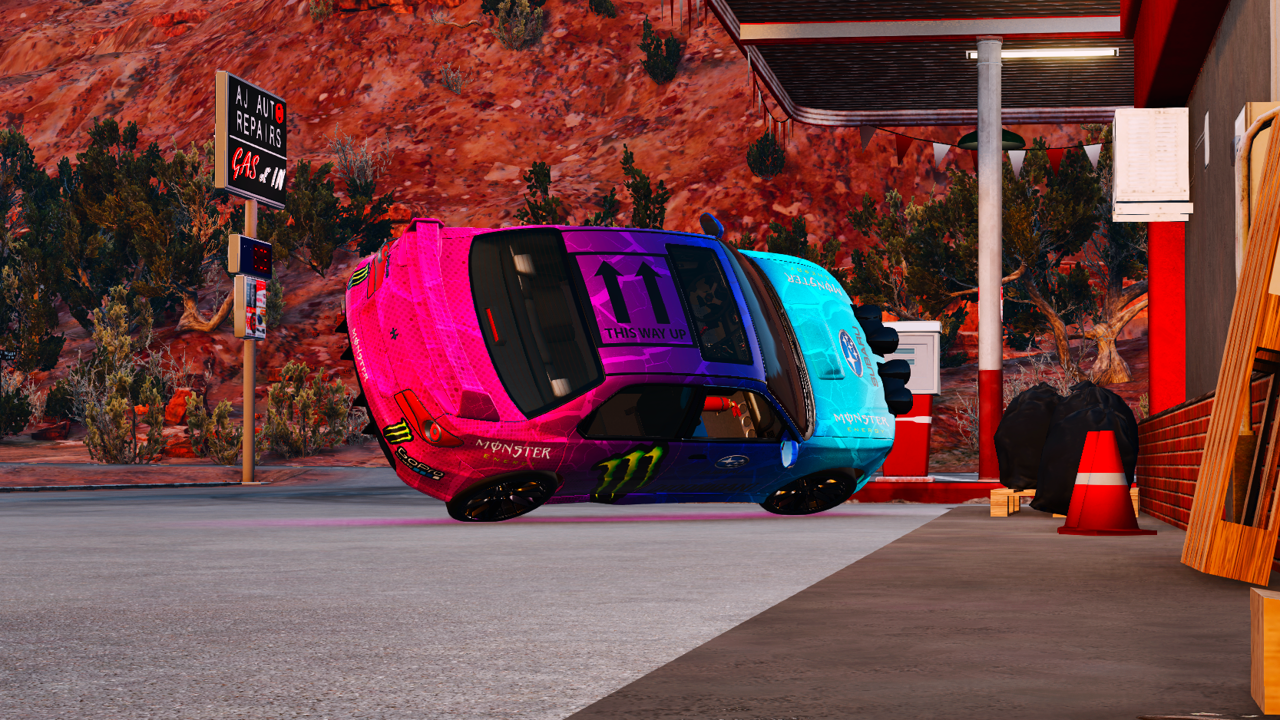
LAW GOVERNING THE USE OF SPECIALIZED VEHICLE LIVERY FOR TWO-WHEELED OPERATIONS
Section 1: Purpose and Scope
This law establishes regulations governing the use of specialized liveries designed for vehicles intended exclusively for two-wheeled operation. These provisions aim to ensure compliance with safety standards, prevent misuse, and provide penalties for violations.
Section 2: Definitions
Livery: A distinctive design or pattern applied to a vehicle for identification, artistic, or branding purposes.
Two-Wheeled Operation: The act of driving a vehicle with only two wheels in contact with the ground, whether performed longitudinally (side tilt) or transversely (front/rear tilt).
Minimum Angle of Inclination: The angle formed between the longitudinal axis of the vehicle and the horizontal ground during two-wheeled operation. For the purpose of this law, the minimum angle of inclination shall be 32.3 degrees.
Vehicle: Any motorized conveyance equipped with the specified livery.
Section 3: Prohibition of Four-Wheeled Operation
Restricted Driving Mode: Any vehicle bearing the livery specified under this law shall be operated exclusively in two-wheeled mode as defined above. Operation on four wheels is strictly prohibited.
Exceptions:
Emergency scenarios wherein a vehicle operator must regain four-wheeled stability to prevent accidents or bodily harm.
Transitioning phases during the initiation or conclusion of two-wheeled operation, provided these phases do not exceed 5 seconds in duration.
Section 4: Minimum Angle Enforcement
Vehicles must maintain a minimum angle of inclination of 32.3 degrees during two-wheeled operation.
Detection and verification of the angle shall be conducted through:
Embedded inclinometer sensors pre-approved by the relevant regulatory authority.
Third-party audits and certified high-resolution video analysis.
Section 5: Penalties for Non-Compliance
Violation Categories and Fines:
Category A: Operating the vehicle on four wheels under non-emergency conditions shall incur a fine ranging from €2,500 to €5,000, depending on the severity and duration of the violation.
Category B: Failure to maintain the minimum angle of inclination during two-wheeled operation shall result in a fine ranging from €1,500 to €3,500.
Category C: Continuous operation on four wheels exceeding 10 seconds, regardless of intent, shall result in the maximum penalty of €5,000.
Aggravated Violations: Violations occurring in high-risk zones, such as populated areas or school zones, shall result in a 50% increase in fines.
Section 6: Enforcement and Monitoring
Vehicles bearing such liveries shall be registered with the local transportation authority.
Operators shall submit proof of compliance with this law annually, including:
Calibration reports from embedded sensors.
Training certificates proving proficiency in two-wheeled operation.
Law enforcement agencies are authorized to conduct random inspections using portable inclinometers and real-time monitoring systems.
Section 7: Appeals Process
Operators penalized under this law may appeal fines within 30 days of issuance.
Appeals must be submitted to the designated municipal court along with evidence of compliance.
Section 8: Effective Date
This law shall take effect six months after its publication to allow operators and manufacturers sufficient time to achieve compliance.